
 jurjen.ladeniusandClaude Opus 4.8
7c24daaf14
jurjen.ladeniusandClaude Opus 4.8
7c24daaf14
Movement previously ended each step by blanking the display, resetting the
scroll offset to 0, bulk-HMMM-shifting the whole viewport back to a canonical
origin, and pasting the new strip. That blank was visible as a flash on every
move.

Treat the 256x256 VRAM page as a torus instead. New g_BaseX/g_BaseY hold the
resting hardware scroll offset (a multiple of 64); a move animates the scroll
register from base to base +/- 64 and fills the newly exposed edge into the
VRAM cells that scroll off the opposite side, then keeps the new offset as the
resting base. No offset reset, no bulk shift, no strip paste, no blank -- so
no flash. All fill targets are base-relative; at base 0 they reduce exactly to
the previous code, and the fill timing is base-invariant.

Route all gameplay VRAM drawing (tiles, sprite, compositors, cat-sense arrow)
through the base via a new WriteVV helper that splits writes at the 256-column
wrap. The minimap overlay draws at absolute coords, so it zeroes the offset
while shown and restores the base on exit.

Co-Authored-By: Claude Opus 4.8 <noreply@anthropic.com>

MSXgl is a Game Library wrote in C and targeting MSX computers.
The purpose of this library is to provide C programmers with the whole set of functionalities to make a game with high performance. Even though a C program can never be as efficient as a program written entirely in assembler, the goal is to try to get as close as possible.
To achieve this goal, the library is dynamically compiled to allow the user to configure the functionalities to best suit his needs. Also, the most expensive features are written in assembler.
The other goal was to create a library that is totally independent of the BIOS. This makes it much easier to use the 16K of page 0. The library also provides interrupt handling code to create ROMs that always remain on page 0.
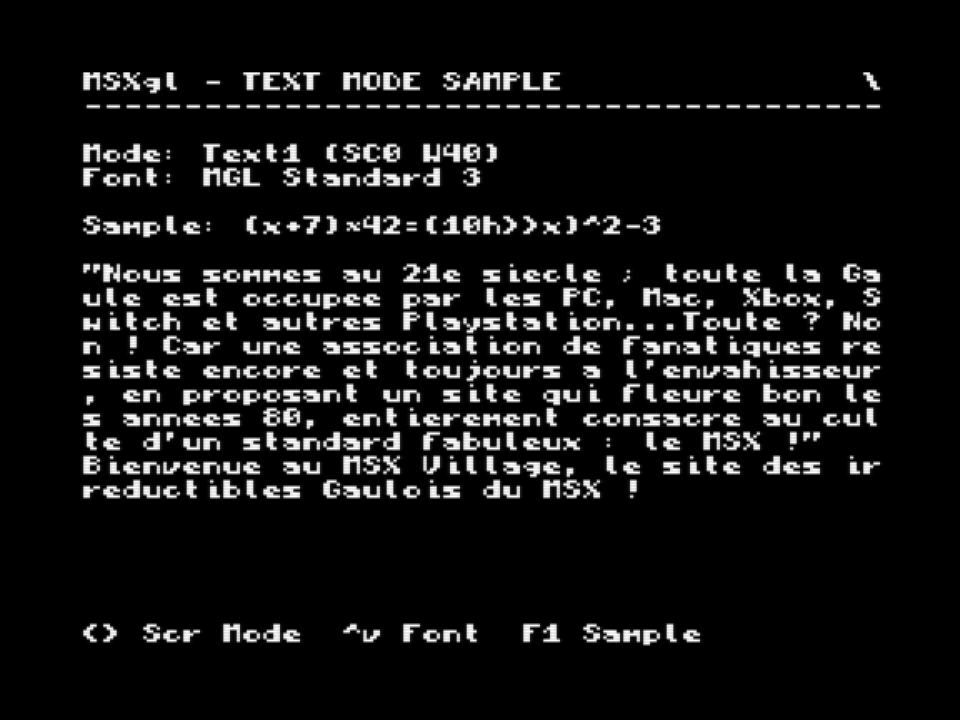
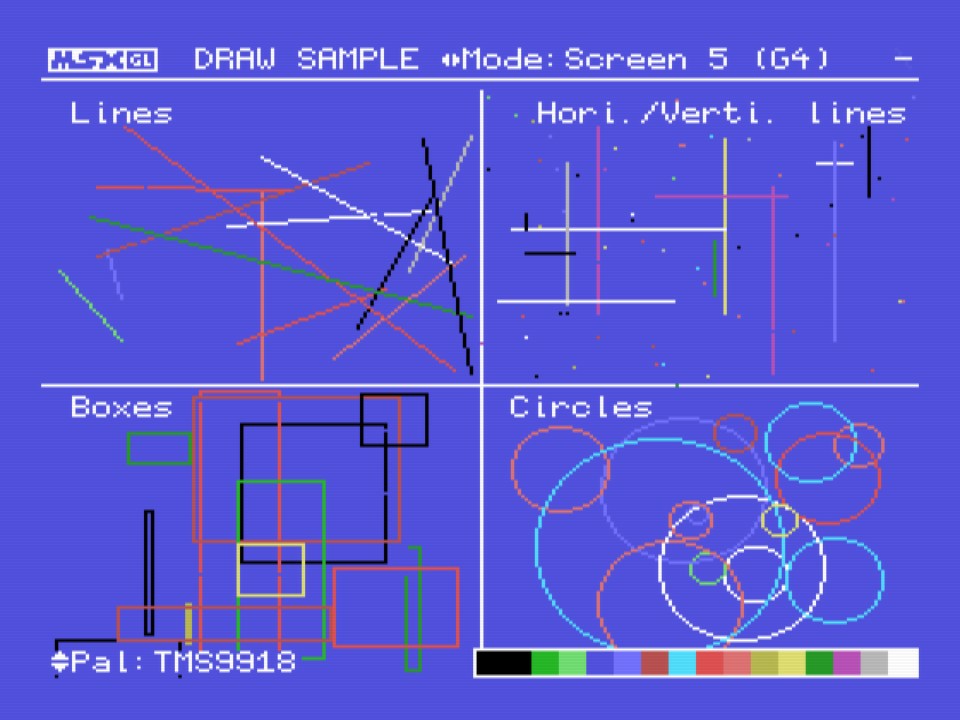
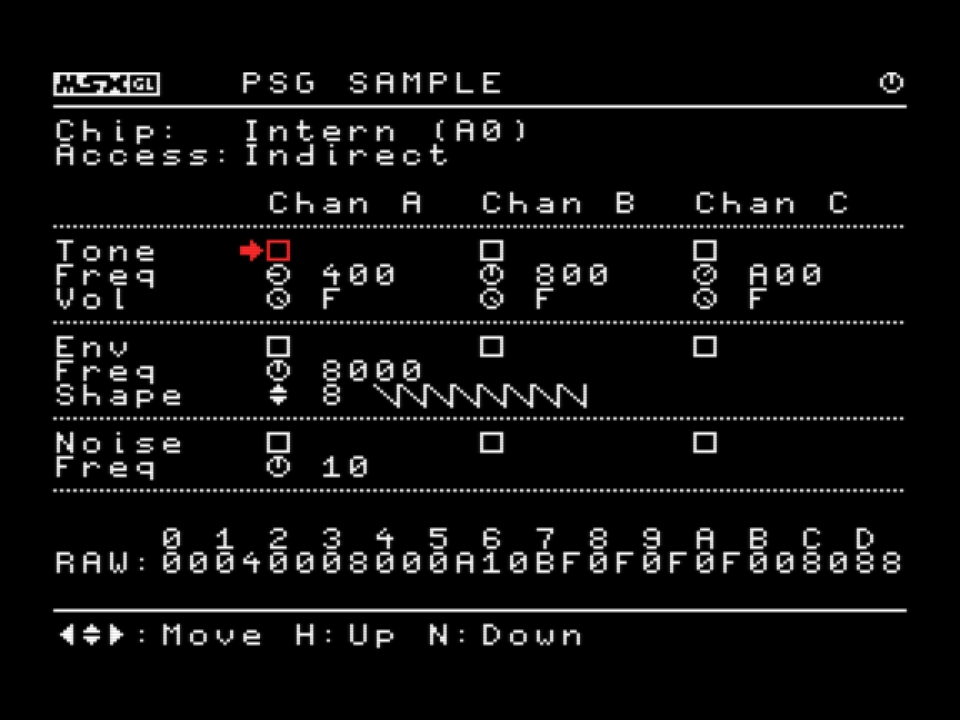
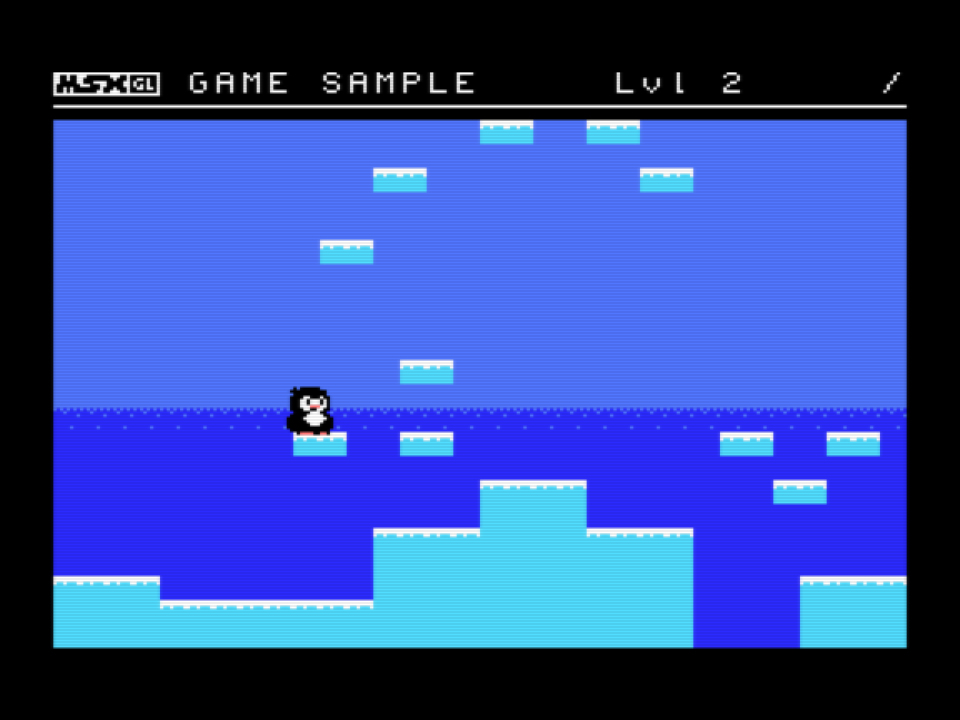
Many sample programs are available to demonstrate the different features of the library.
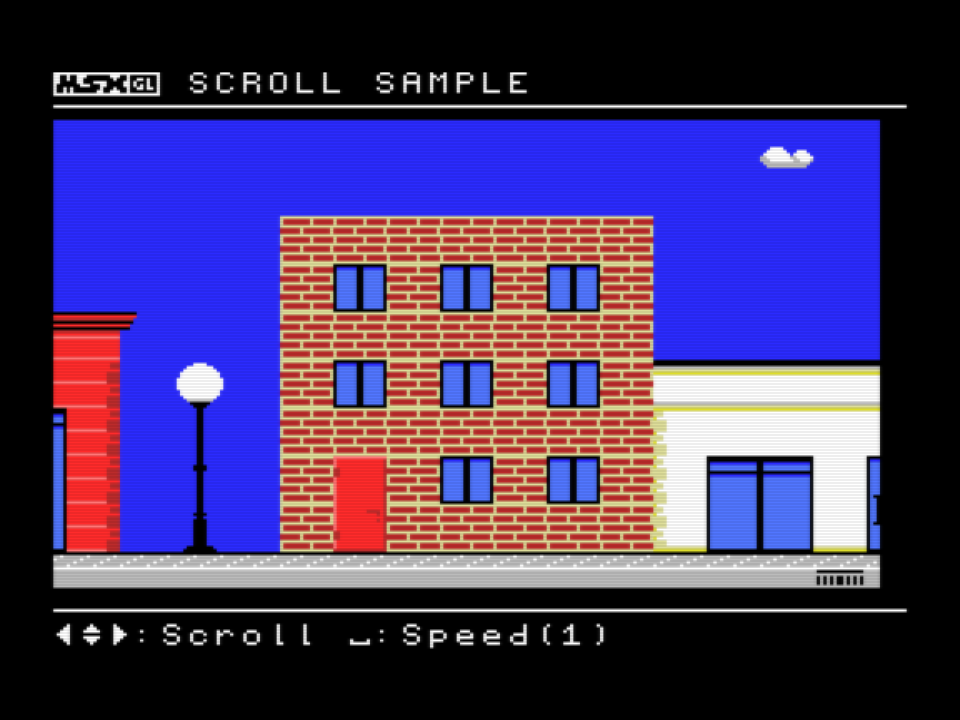
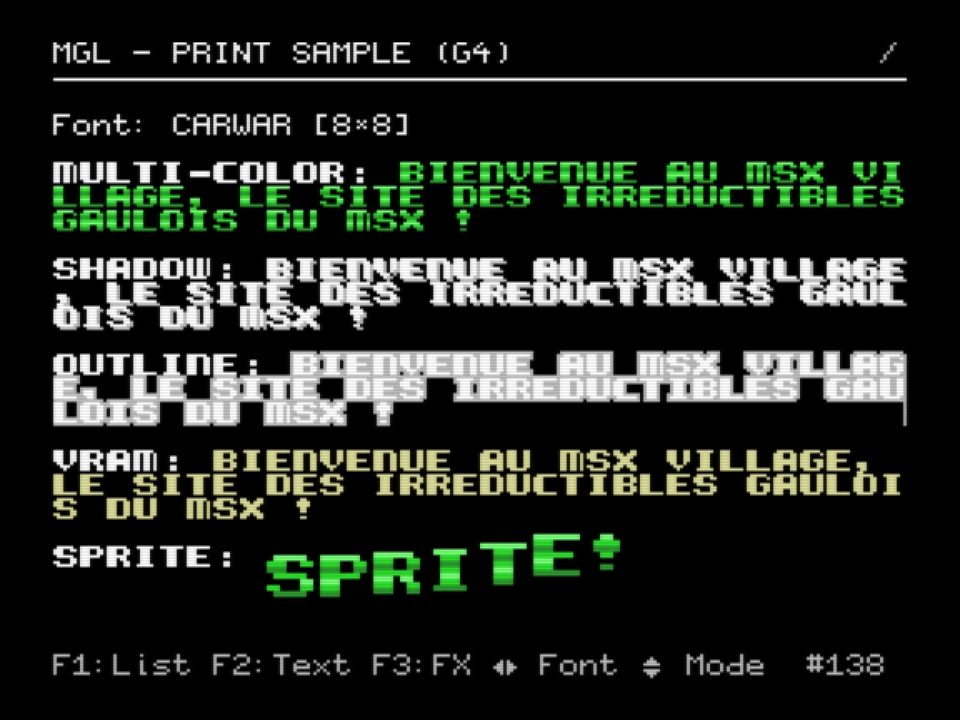
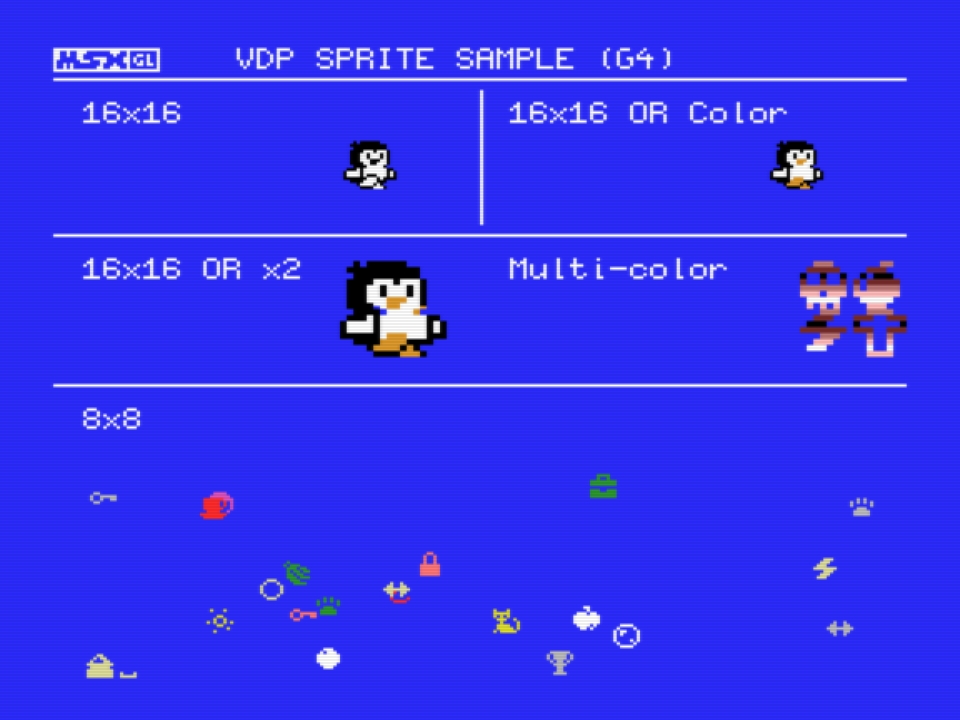
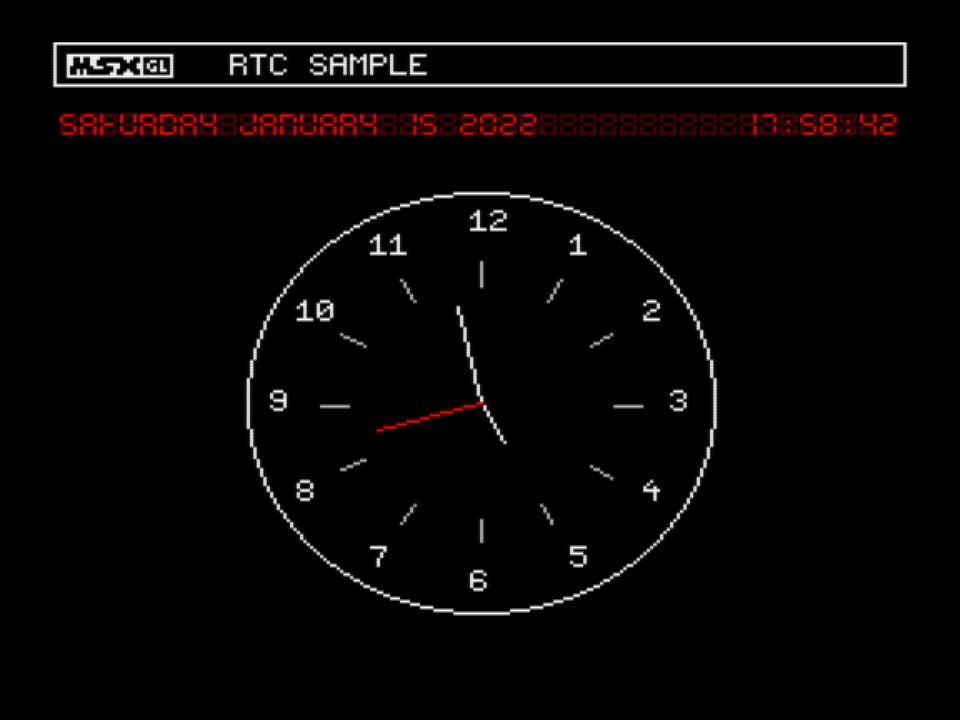
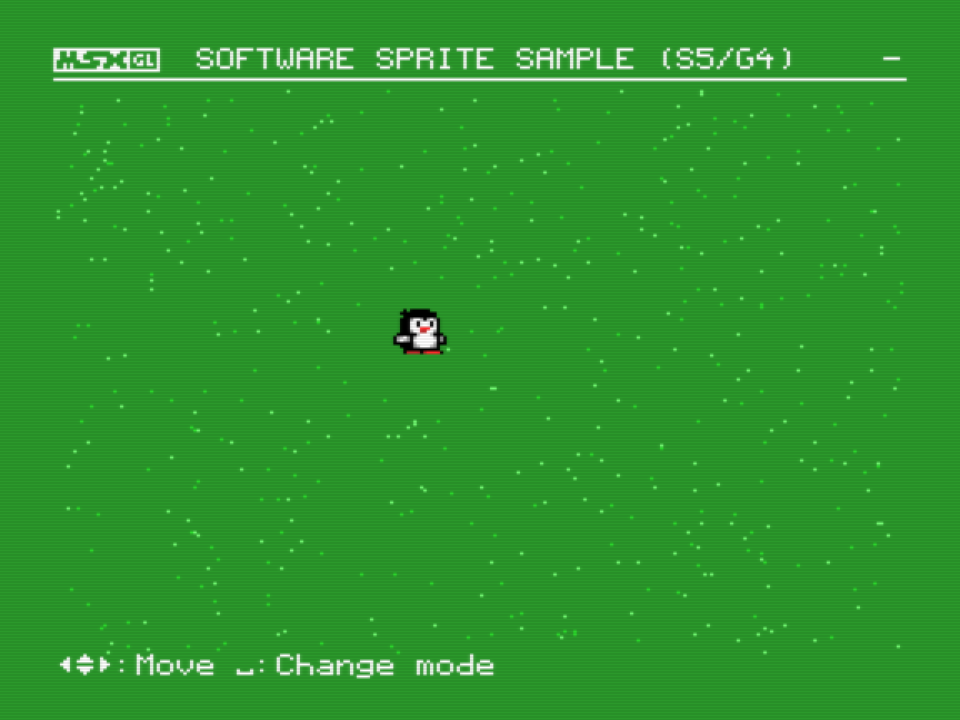
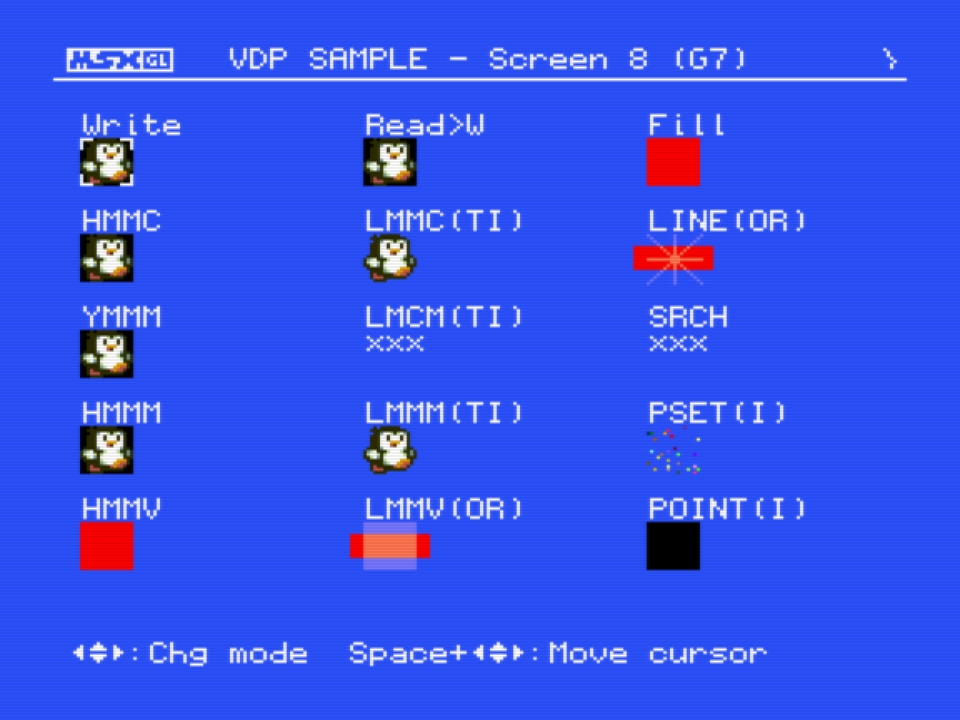
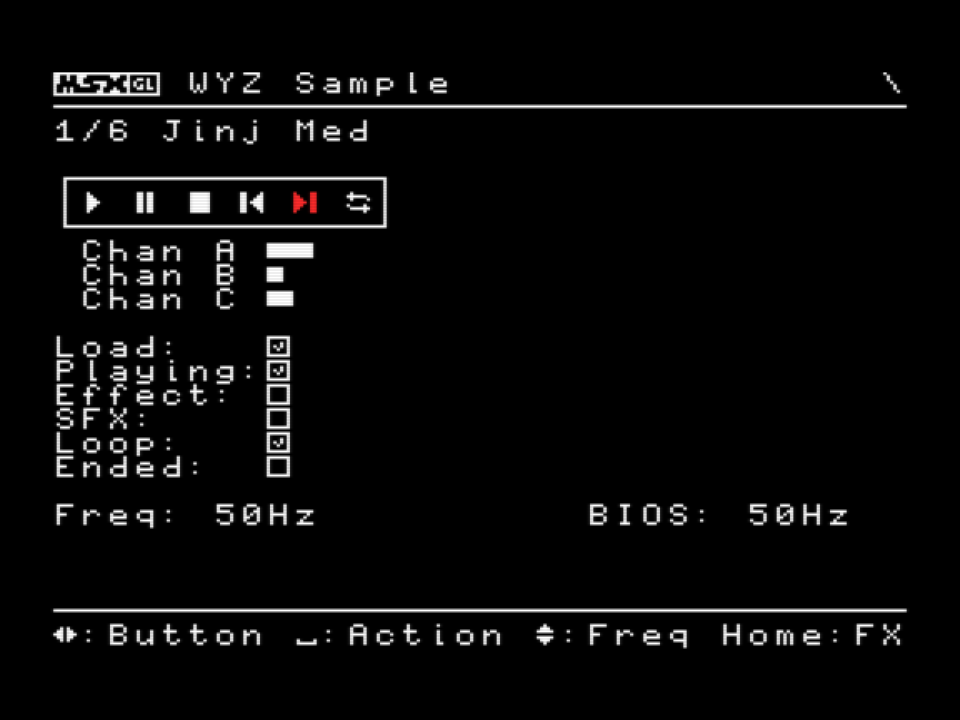
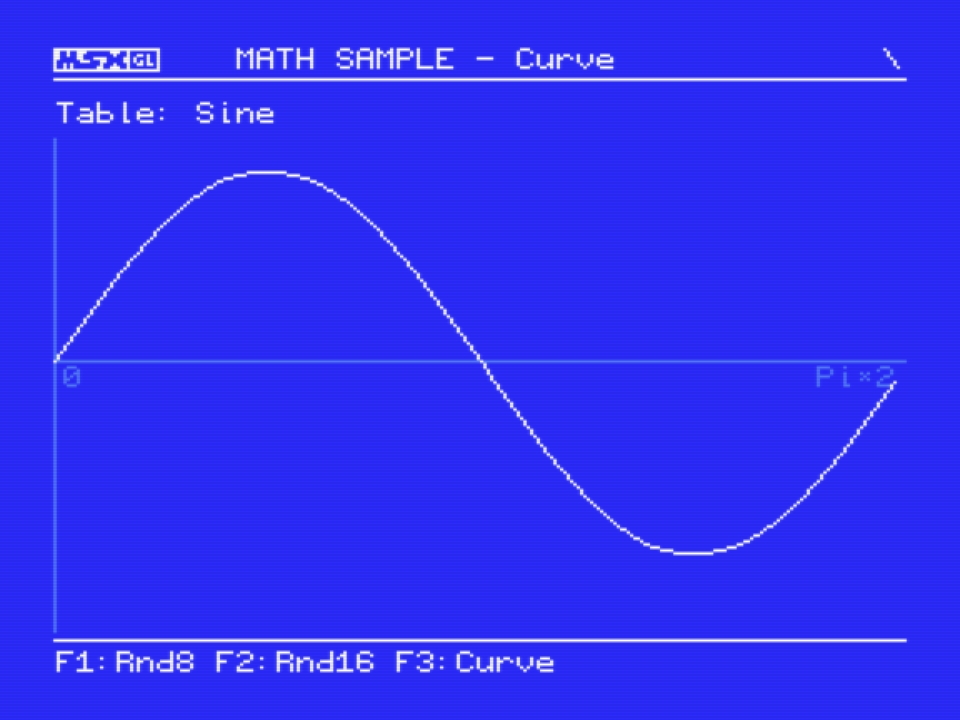
The MSXgl Build Tool allows you to create a final program for a large number of formats with just 1 click:
- Plain ROM from 8K to 64K (interrupt handler can be installed in page 0),
- Mapped ROM from 64K to 4096K (ASCII-8, ASCII-16, Konami and Konami SCC mappers),
- MSX-DOS 1 or 2 binary program,
- BASIC binary program.
The library supports the following devices:
- VDP (TMS9918, V9938 and V9958) and V9990,
- PSG (AY-3-8910), MSX-Music, MSX-Audio, Konami SCC,
- Keyboard, Joystick, Mouse and Ninja Tap (4 joysticks adaptator),
- ROM mapper, slot manager, and Real Time Clock (RP-5C01).
Here are also the supported audio formats:
- Arkos Tracker 2 (AKG, AKY and AKM)
- Trilo Tracker SCC
- Vortex Tracker II (PT3)
- WYZ Tracker (WYZ)
- ayFX
- VGM (for all supported audio chip)
- lVGM (a light-VGM format for for all supported audio chip)
- PCM-Encoder (aka. Crystal clean PCM 8bit samples on the poor PSG)
Many thanks to the members of the MSX Resource Center and MSX Village who have been very helpful. The library is distributed under the Creative Commons BY-SA license. Tools or sources from other authors may use another free license.
Documentation:
- Code documentation: /engine/doc/html/ or https://aoineko.org/msxgl-doc
- Library documentation: https://aoineko.org/msxgl
If you have any question, feel free to join the MSXgl Discord server.
This work is licensed under CC BY-SA 4.0

